
How much capital do you need to start a rental business? A guide to boarding house ROI
Thinking of starting a rental property but unsure about the capital required? Learn initial capital estimates, income projections, how to calculate ROI, and payback periods.
“How much capital do I need to open a rental business?” This is the first question that comes to mind for anyone interested in the rental property market. The answer isn’t a single number, because required capital depends heavily on location, scale, and the standard of property you want to build.
More important than the “how much capital” question is: how long until payback, and how profitable is this investment long-term?
This article covers both, initial capital estimates by rental scale, income projections, how to calculate ROI (Return on Investment), and the factors that determine whether your rental property will be profitable or not.
Note: this guide uses examples from the Indonesian rental market (mid-sized cities like Yogyakarta, Malang, Bandung). Numbers are in Indonesian Rupiah with USD equivalents; roughly Rp 15,000 = $1 USD at time of writing. The ROI framework is universal.
Capital components of a rental property business
Before jumping to numbers, it’s important to understand what’s included in rental business capital. Many prospective investors only account for building costs and forget other components that are just as significant.
1. Land and building
This is the biggest and most decisive component. Land prices vary wildly by location, land near a university in Yogyakarta can be far more affordable than land in South Jakarta with similar commute times.
Available options:
- Build from scratch on your own land: highest capital, but maximum design flexibility
- Renovate an existing house: cheaper, but limited by the existing structure
- Buy an operating rental building: can generate income immediately, but higher purchase price
- Build on long-term leased land: lower initial capital, but there’s contract risk
2. Renovation and construction
Even if you already have a building, renovation costs to turn it into a livable rental property can be significant. This includes:
- Building or renovating bedrooms
- Bathrooms (private or shared)
- Kitchen and common areas
- Electrical and water installation
- Painting and finishing
- Fencing and security
3. Furniture and room equipment
The furniture standard you provide significantly affects the rent you can charge. Typical per-room preparation:
| Item | Standard Room | Premium Room |
|---|---|---|
| Mattress + frame | Rp 1,000,000–1,500,000 (~$70–100 USD) | Rp 2,500,000–5,000,000 (~$170–330) |
| Wardrobe | Rp 500,000–800,000 (~$35–55) | Rp 1,500,000–3,000,000 (~$100–200) |
| Desk + chair | Rp 300,000–500,000 (~$20–35) | Rp 800,000–1,500,000 (~$55–100) |
| Air conditioner | Rp 2,500,000–3,500,000 (~$170–235) | Rp 4,000,000–6,000,000 (~$270–400) |
| Water heater | Rp 500,000–800,000 (~$35–55) | Rp 1,500,000–2,500,000 (~$100–170) |
| Total per room | Rp 5–7 million (~$335–470) | Rp 10–18 million (~$670–1,200) |
4. Shared facilities
- WiFi (router + subscription): Rp 1,500,000–3,000,000 setup + Rp 300,000–600,000/month
- CCTV: Rp 2,000,000–5,000,000 depending on number of cameras
- Water dispenser / shared kitchen: Rp 500,000–2,000,000
- Shared washing machine (optional): Rp 2,000,000–4,000,000
5. Permits and administration
Often ignored, but important for long-term business continuity:
- Building permit (IMB or PBG in Indonesia)
- Business license
- Business tax registration
- Notary fees (for formal agreements)
Estimate: Rp 2,000,000–10,000,000 (~$135–670) depending on complexity and area.
6. Working capital
Reserve funds for 3–6 months of operation before the property fills up:
- Electricity and water bills
- Caretaker / cleaning-service salary (if any)
- Unexpected maintenance costs
- Initial marketing costs
Capital estimates by rental scale
Here’s a rough picture of capital required for three common scenarios. These figures assume location in a mid-sized city like Yogyakarta, Malang, or Bandung, not Jakarta or Bali where costs are much higher.
Small rental: 5–8 rooms
Suitable for beginners who are just starting, or those using part of an existing house.
| Component | Estimate |
|---|---|
| Renovation/construction | Rp 80,000,000–150,000,000 (~$5,300–10,000) |
| Furniture & AC (7 rooms × Rp 7M) | Rp 49,000,000 (~$3,300) |
| Shared facilities | Rp 10,000,000 (~$670) |
| Permits | Rp 3,000,000 (~$200) |
| 3 months working capital | Rp 8,000,000 (~$535) |
| Total (without land/building) | Rp 150,000,000–220,000,000 (~$10,000–15,000) |
Note: If you need to buy land and build from scratch, add Rp 300,000,000–700,000,000 (~$20,000–47,000) depending on location.
Mid-size rental: 10–15 rooms
The most common scale, often considered most efficient for ROI.
| Component | Estimate |
|---|---|
| Renovation/construction | Rp 200,000,000–350,000,000 (~$13,300–23,300) |
| Furniture & AC (12 rooms × Rp 7M) | Rp 84,000,000 (~$5,600) |
| Shared facilities | Rp 20,000,000 (~$1,335) |
| Permits | Rp 5,000,000 (~$335) |
| 3 months working capital | Rp 15,000,000 (~$1,000) |
| Total (without land/building) | Rp 324,000,000–474,000,000 (~$21,600–31,600) |
Large rental: 20–30 rooms
Requires bigger investment but income potential is much higher.
| Component | Estimate |
|---|---|
| Renovation/construction | Rp 400,000,000–700,000,000 (~$26,700–47,000) |
| Furniture & AC (25 rooms × Rp 8M) | Rp 200,000,000 (~$13,300) |
| Shared facilities | Rp 40,000,000 (~$2,700) |
| Permits | Rp 10,000,000 (~$670) |
| 3 months working capital | Rp 30,000,000 (~$2,000) |
| Total (without land/building) | Rp 680,000,000–980,000,000 (~$45,300–65,300) |
Income projection
Now that you know the capital, let’s calculate potential income.
Factors that determine rental rate
- Location: Near a university, city center, or industrial area typically commands higher rates
- Facilities: AC, private bathroom, WiFi, water heater significantly bump up the rate
- Room size: Rooms above 3×4 meters can be priced higher
- Area occupancy: If neighboring rentals are always full, you have room to price higher
Example income projection (12-room rental, mid-sized city)
| Scenario | Rate/room | Occupancy | Monthly income |
|---|---|---|---|
| Conservative | Rp 1,200,000 (~$80) | 80% (10 rooms) | Rp 12,000,000 (~$800) |
| Moderate | Rp 1,500,000 (~$100) | 90% (11 rooms) | Rp 16,500,000 (~$1,100) |
| Optimistic | Rp 1,800,000 (~$120) | 95% (11 rooms) | Rp 19,800,000 (~$1,320) |
Monthly operating costs (12 rooms)
| Expense | Estimate/month |
|---|---|
| Electricity (common area + shared usage) | Rp 800,000–1,500,000 |
| Water | Rp 300,000–600,000 |
| WiFi | Rp 400,000–600,000 |
| Caretaker/cleaning salary (if any) | Rp 800,000–1,500,000 |
| Routine maintenance | Rp 300,000–600,000 |
| Rental tax (10% of gross under Indonesian final-tax scheme) | Rp 1,200,000–1,980,000 |
| Total expenses | Rp 3,800,000–6,780,000 (~$255–450) |
Estimated net profit (moderate scenario): Rp 16,500,000 – Rp 5,000,000 = Rp 11,500,000/month (~$770)
How to calculate rental ROI
ROI (Return on Investment) is the most important figure to evaluate before deciding on a rental investment.
Annual ROI formula
ROI (%) = (Annual Net Profit ÷ Total Investment) × 100%Payback period formula
Payback Period = Total Investment ÷ Annual Net ProfitReal calculation example
Assumptions:
- 12-room rental in a mid-sized city
- Total investment (including land + building): Rp 700,000,000 (~$47,000)
- Monthly net profit: Rp 11,500,000 (~$770)
- Annual net profit: Rp 138,000,000 (~$9,200)
Annual ROI:
ROI = (Rp 138,000,000 ÷ Rp 700,000,000) × 100% = 19.7%/yearPayback period:
Payback = Rp 700,000,000 ÷ Rp 138,000,000 = ±5.1 years19.7% annual ROI is very attractive compared to other investment instruments. Bank deposits yield only 4–6% per year, money market funds around 5–7%. Even blue-chip stocks average 10–15% per year with much higher volatility.
Healthy rental ROI benchmarks
| Annual ROI | Assessment |
|---|---|
| Below 8% | Suboptimal, consider other investment instruments |
| 8–12% | Decent, especially if property value also appreciates |
| 12–18% | Good, above average conventional instruments |
| Above 18% | Excellent, typically in strategic locations or efficiently managed |
Important: The ROI figures above don’t account for capital appreciation. In many cities, property values rise 5–10% per year, which means total rental business ROI can be much higher than rental income alone.
Factors that most affect your rental ROI
Location is everything
Rentals near a major university, hospital, or industrial area almost always have high occupancy year-round. Rentals in less strategic locations can struggle below 70% occupancy, which directly erodes ROI.
Before buying property, research: how many rental properties exist within a 500-meter radius? Are they always full? What are the rates? This gives a realistic picture of market potential.
Occupancy rate vs. rental rate
The two main levers of rental income are rate and occupancy. Finding the right balance between them is key. A rental priced at Rp 2,000,000 but only 70% occupied generates less than a Rp 1,500,000 rental with 95% occupancy.
Monitor your occupancy consistently. If it’s always above 90%, that’s a signal you can raise rates. If below 75%, consider rate adjustment or facility upgrades.
Operating cost efficiency
Uncontrolled costs can silently cut your ROI. Landlords who don’t track expenses neatly often don’t realize how much “leaks” every month, from oversized electric bills to undocumented repair costs to tax penalties for late filing.
Efficient management
Rentals managed with a good system, digital payment tracking, tidy contracts, organized tenant data, tend to have higher occupancy and lower tenant turnover. Tenants stay longer at professionally managed properties.
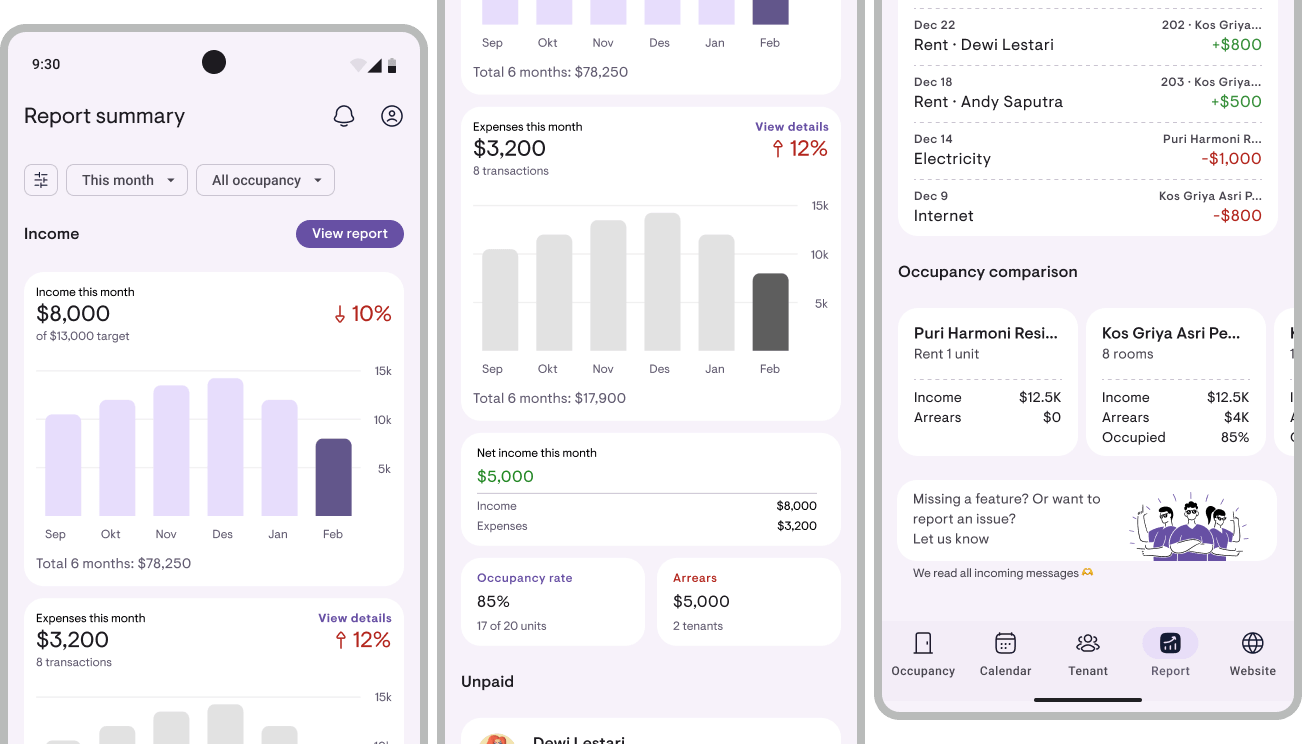
Apps like Kamaru help you track payments, monitor occupancy status, and generate financial reports, so you can make business decisions based on data, not guesses.
Tips to maximize your rental ROI
1. Start with what you have If you have a house with unused rooms, converting them into rental units can deliver very high ROI because initial capital is minimal.
2. Invest in facilities that raise rent Air conditioning and private bathrooms are the two most significant facilities that raise rent. Their investment cost can return in 12–18 months from the rent premium.
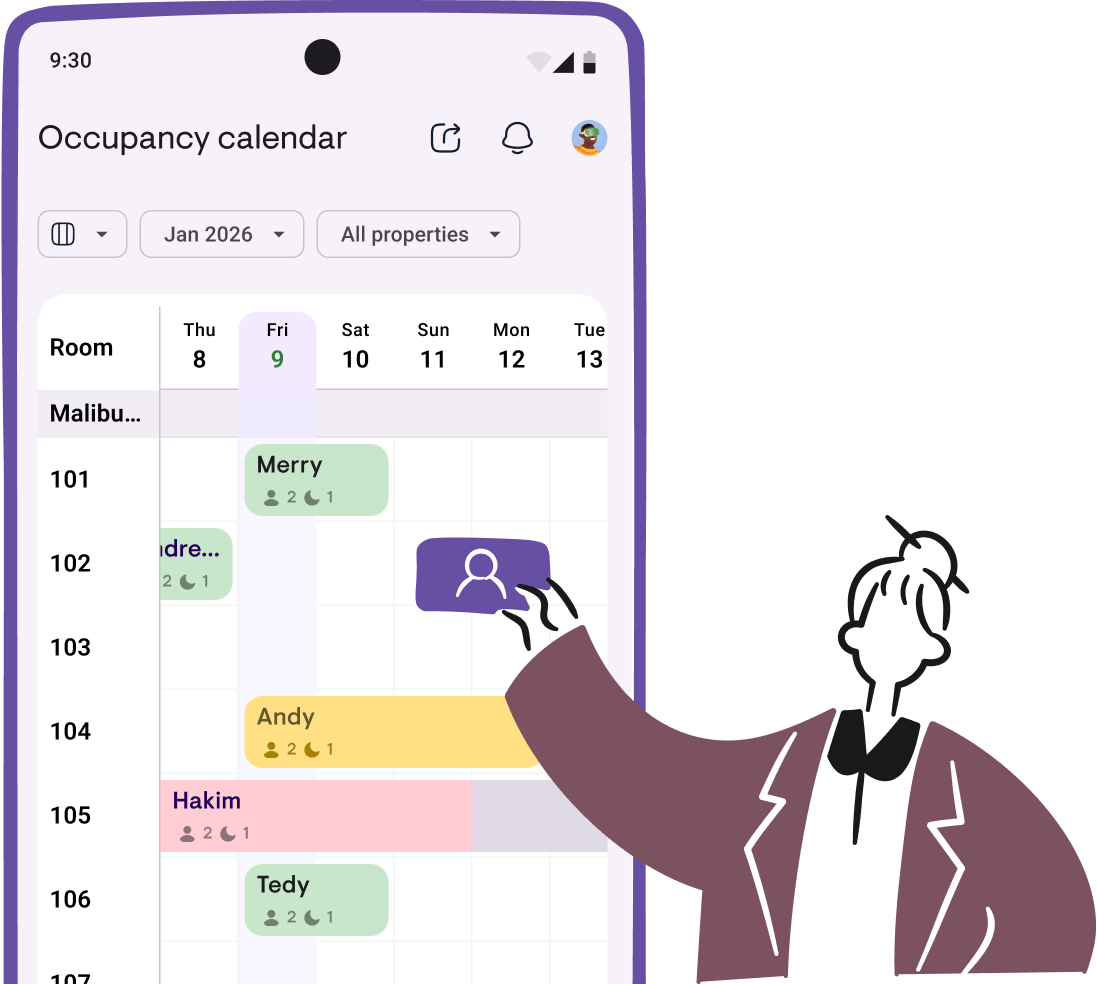
3. Actively manage occupancy Don’t let rooms sit empty for weeks. As soon as there’s a sign a tenant is leaving, start active marketing. Use an occupancy calendar to predict when rooms will be empty.
4. Raise rates periodically Many landlords never raise rent for years. A 5–10% increase every 1–2 years is reasonable, and almost every satisfied tenant will accept a transparent, well-communicated raise.
5. Reduce tenant turnover Every tenant changeover means a period of empty room, cleaning cost, and admin time. Long-staying tenants are assets, maintain good relationships with them.
6. Record all income and expenses You can’t optimize what you don’t measure. Track all numbers consistently so you know exactly where your ROI can be improved. Read: How to create clean rental financial reports.
Rental property vs. other investment instruments
| Instrument | Annual Return | Risk | Liquidity |
|---|---|---|---|
| Rental property | 12–20%* | Low–Medium | Low |
| Bank deposit | 4–6% | Very low | High |
| Mutual funds | 6–12% | Medium | High |
| Stocks | 10–20%+ | High | Very high |
| Gold | 8–12% | Low | Medium |
*Includes estimated property appreciation of 5–8% per year
Rental property wins on the combination of competitive return + relatively low risk + stable monthly cash flow. The weakness is low liquidity, property can’t be sold quickly if you need cash urgently.
Conclusion
The rental business is one of the most solid investments in Indonesia when done with careful planning. A 15–20% annual ROI plus property appreciation is hard to match with conventional investment instruments of comparable risk profile.
The keys:
- Choose location carefully: this is the biggest factor determining ROI
- Calculate capital realistically: don’t forget hidden costs
- Project income conservatively: assume 80% occupancy, not 100%
- Manage efficiently: every uncontrolled expense cuts your ROI
Once your rental is operating, tidy management is key to sustaining high ROI. Try Kamaru free, track payments, monitor occupancy, and see your rental’s financial reports in one app. Setup takes just 5 minutes.
Related articles
Have questions or feedback? We'd love to hear from you. Email us.

Start managing for free today
Join other landlords who are already using Kamaru to manage their properties.

